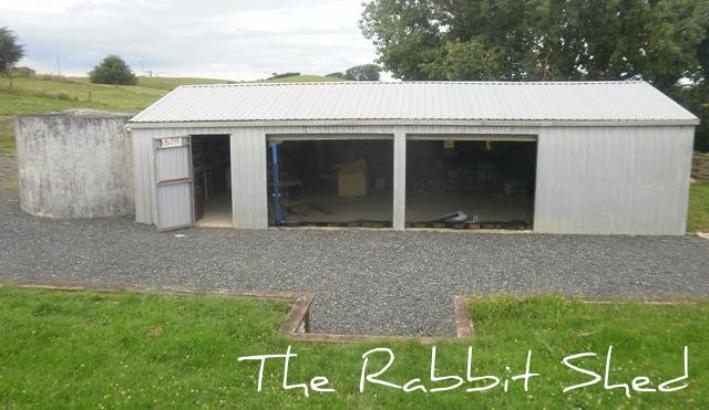
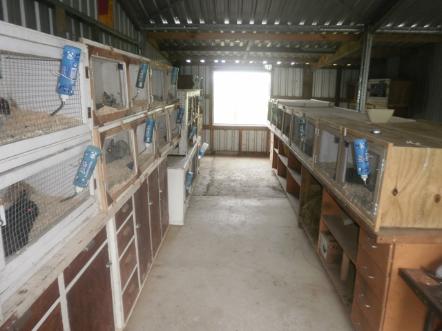
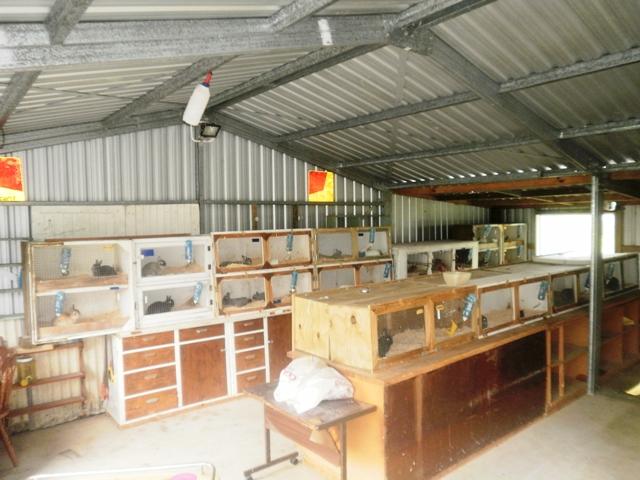
Our Rabbit Shed - I have the doorways covered with Shade Cloth - this keeps the rabbits cool, well ventilated and fly free!
 |  |
Netherland Dwarfs are the smallest Domestic Rabbit Breed, weighing in at a maximum show weight of 1.13kgs for a fully grown adult. They should be compact and cobby in type with short well-furred, rounded ears at an approx length of 5cms. I have found my ND's to be quite hardy when kept in good conditions, quiet and friendly, though not as outgoing as some of the other smaller breed rabbits.
My Netherland Dwarf Stud is a combination of three main foundation stud lines - Chelsea Buns, Salopian and Westhaven.
I have written below what I have learnt over the last few years, with some tips and other info. I am no expert and the day I stop listening and learning, is the day I will be ready to give up, so please bear in mind that these are MY experiences and MY opinion only.
---------------------------------------------------------------------------------------------------------------------------------------------------------------------------------------
Netherland Dwarfs are a challenging breed to keep, they must be fed correctly to keep them in condition without over feeding them which will cause overweight rabbits that have health and breeding difficulties. It takes careful management to find the correct balance, especially while growing, as a rabbit kept under optimum condition will lose weight around the 'pins' or hips, and once you can feel those pins, you can never put the same roundness back into them, despite getting the rabbit back into condition. With the small portion they eat, you need to be sure they are getting the right nutrients.
I feed mine on Country Harvest Rabbit Pellets, and although they are the more expensive brand, I find they work very well with my ND's regardless of age. I have trialled other brands, but found that they have been inconsistent in how much I need to feed each rabbit, some were getting fat on their portion, others were losing weight. I find Country Harvest to be great for ALL the rabbits at the same portion level, give or take a bit when moulting. Once a week I feed a Rabbit Mix from the Straw Warehouse instead of the pellets, this is a mix consisting of different grains, molasses and chaff (it is fattening, but also gives good shine to the coat, and the bunnies love it!).
On a Sunday, the adults are fed hay only, an older breeder put me on to this system and it works well for me. Fibre is a must for rabbits, and fresh good quality hay is essential to their diet, but I found that alot of my bunnies would not eat the hay when it was given freely, so by taking their pellets away for a day, and giving them a handful of hay instead, all are eating the hay and this has absolutely no effect on their condition - other than to improve their digestive systems and general health! All young litters however are given fresh handfuls of hay every two-three days, especially as they are coming out of the nest, as this I find has helped their digestive systems adjust to food, and gives them something preferable to chew so they aren't picking up other bits on the cage floor to nibble at. Clean water is a must, a rabbit without water will not eat, a non eating rabbits gut will shut down without food, so clean fresh water in water bottles is a must have. If for some reason a rabbit has stopped eating, I find blackberry leaves a great health tonic and pick-me-up, and to date it has not failed me in getting a rabbit refusing food, to eat. My rabbits are all given greens, freshly picked each morning. This is usually dandelion leaves, Puha, Plantain or Garden veges.
My Nethies are housed off the ground, indoors, in a well ventilated shed, this way they are protected from the elements and predators. I find that a cage too big makes them feel threatened, they become scatty and territorial. A cage too small will soon have them depressed. My bucks enjoy square cages where the whole front is wire door, this encourages them to come to the door and to sit up and show themselves off. My does have longer cages so that they can get away from their litters when they have them. Again the whole front opens up, I find this preferable to nesting areas which encourage them to hide and be less sociable. Does are given nesting boxes for privacy when they are due to kindle. All my bunnies are well handled and greet me at the door.
When choosing which does to breed with which bucks I take careful consideration of a few key factors. I do line breed, and the reason why is simple - it works! I was taught the old fashioned way, in which to build a line for yourself you start with one buck and two does. Off-spring is put back to the mother/father and so on. Line Breeding works by 'locking' in the desired traits. If the genes are closer together, then you have a better chance of keeping the desirable traits in and by careful selection, you can quickly and effectively breed out any faults. The most important thing I have learnt with line breeding is that it does not CAUSE defects/problems, you can not make something appear without it already being there, whether hidden or blatantly obvious. What it does do is bring those defects/faults/problems to the surface quicker, and this is why when line breeding you need to be very careful on selection, and weeding out what is not desirable.
I keep comprehensive records on each of my rabbits, with a type/fur/condition score, weight, any faults they may have, as well as what they produce to which buck. This is especially helpful for getting to know my stock and what is hidden behind them. My main rule is to never mate two bunnies together with the same fault.
Show training begins from birth, by keeping the rabbits cage clean which encourages cleanliness in the youngsters. Kits are handled from day one, and my first selection takes place around four weeks. If a kit looks good at four weeks (type wise - not just cute!) then nine times out of ten, they will come back to that as an adult. Kits are encouraged to sit up and show themselves off. I do this by placing the rabbit in one spot, and moving it back every time it tries to move away. They catch on pretty quick to stay in one spot. I then teach them to tuck themselves up, hold their head up and show off their chest. By the time they are 12 weeks, they are little experts! Kits go through a couple of 'ugly' stages, the first being about 6-11 weeks, then again around 13-15 weeks. The bucks especially, take a long time to fill out, often not looking good again til 12ish months, whereas the does tend to be fully developed at 5-6 months. A good rule of thumb for me is I look at my bucks at 12 weeks, and if their ears are longer than 5cms, I don't keep them. At 12 weeks their ears are the most out of proportion to their body, after this I find the ears stop growing and the body grows into the ears. I have also found it good practice to grow youngsters on, I have been caught out with letting something go before giving it a chance to grow into itself, only to see it a few months down the track looking outstanding!
When selecting breeding does, I look for good width and size, I keep what are affectionally known as Big Ugly Does (BUD's) as long as they have positive attributes I am not concerned on size/weight. A small petite doe is not going to produce well. Often the does with the short compact bodies are better suited as show bunnies than brood does, as they do sometimes encounter breeding problems, resulting in stuck kits etc. There is an old saying that while the show doe is out winning at the shows, her BUD sister is at home breeding the next generation of show winners.
Max Factor and Peanuts
Breeding show Nethies is slow progress, they generally have between 2-4 kits in a litter, and are good mothers, though they are affected by a few lethal genes. Being a Dwarf breed, when there is a double up of the dwarfing gene, this results in what is commonly referred to as a 'peanut'. True peanuts cannot survive and if not humanely dispatched, will eventually die within a week of being born.
There is also a gene referred to as the 'Max Factor' gene. These are recognisable in the nest by the distinct feature of being born with their eyes open. In a normal litter, kits are born with their eyes shut and they don't open until 12-14 days old. When the Max Factor gene is present, the kits eyes are open and often there are other deformities present too, such as frog legs, twisted feet or umbilical hernias. In my experience, these kits have passed away naturally in a week, similar to the peanuts, however overseas breeders have recorded progress of these kits when they survive, having grown into blind rabbits, with a coarse hair rather than soft fur and deformities of the limbs. They are prone to eye infections due to the fur and bedding material getting stuck in the eyes, and I personally find it kinder to humanely dispatch any Max Factors present at birth.
The Max Factor gene, is in fact recessive - which means that both parents must carry the gene for it to show up in the litter. The gene is easily recognisable in a 'carrier' once you are experienced enough to know what you are looking for, by the extra 'tuft' of fur between the ears and the different texture to the coat.
There is controversy over the gene, which alot of breeders say is a must have in your lines to obtain the best possible type, the saying goes that where there is a max factor in the litter, the rest of the litter will be outstanding in type. I have done my own research with this and coupled with my own experiences, have come to the conclusion that because the gene is responsible for a different type of coat, which is longer with more guard hairs, which in turn give the rabbit that carries the Max Factor gene, the illusion of having a fuller, rounder head and shorter ears (thanks to the longer tuft).
A Controversial Subject.... (please bear in mind I am not a vet, this is only my own experiences and conclusions)
Another problem I have encountered with the Nethies, is the kits not thriving. This tends to show itself at about four weeks old, with the kit seemly unable to eat/digest solid food, and they literally just fade away. They don't run around with the other littermates, but sit slightly hunched over, fluffed up, and with a dull eye. Despite my best efforts, I am yet to save one, and don't yet have a concrete reason for why this occurs, other than it appears to be directly related to the weaning stage. The kits have done well on mums milk, being healthy, well sized and robust, until such time as milk alone is not enough and they need solid food. Whether their digestive system is not correct or not, I do have a few theories, though probably rather controversial.
My main theory as to this 'fading' is that it is linked to the E.Cuniculi protozoa. E.Cunuculi or Encephalitozoon Cuniculi as it is correctly called, is a protozoa that lives harmlessly in most domestic rabbits. It is unknown why some rabbits are effected by it, as to whether the damage is caused by an immune response or by the protozoa itself. E. Cuniculi is ingested and from the gastro tract, travels through the blood stream and into the Kidneys and other organs. It is contagious while it is in the kidneys, and is passed on via spores shed in urine. When a rabbits immune system becomes compromised (stress, moult, lack of water, a cold draught etc) the protozoa can then begin to multiply, take control and attack the rabbits neurological system. This we can see as wry neck, or loss of use of limbs, blindness etc. The reasons I think this parasite is responsible is because of conclusions I have come to from my own experiences.
When I took on a very well bred small stud of Nethies, the stock was under fed, in poor condition, and dirty (not by the original breeder). During the months that followed I cared for these bunnies, and I experienced for the first time, wry neck in two of the adults, one a recently kindled doe, the other a buck who was a 'sprayer'. The directly related stock was also giving me way beyond a normal percentage of 'fader' kits. Feeling a little lost and frustrated over the fatalities, and trying my best to save a top quality line of Nethies, I did some research, and found that alot of overseas breeders were accounting E Cuniculi to be responsible for Wry Neck. I did many months of research, reading all I could on the internet, and discovered that some breeders were blaming the E Cuniculi for nestbox faders too. During my research I discovered that because the spores are shed via urine, rabbits that spray, and kits from 'nest box wetters' (does that pee in their nestbox), gave higher incidences of E.Cuniculi outbreaks. I now thought perhaps I was onto something.
Upon further research, I discovered that to treat E.Cuniculi, daily doses of Panacur were needed for six weeks and the whole shed were to be treated, though this was not often effective and more often than not the affected rabbit would relapse in time. I also discovered that ivomectin was used in an oral dose to 'freeze' the parasite and its progress, and that a weak solution of bleach will kill the spores. Armed with this knowledge, the next bunny I discovered to present with a very early head tilt, I gave a large dose of ivomec, and cleaned the cage out with bleach. The illness did not progress and the rabbit didn't get worse. So, I dosed the whole lot with ivomec, and put them all on a three monthly dosage plan, and cleaned their cages with a weak solution of bleach once a week. I never had another nethie with wry neck again, and to top it off, the nest box 'faders' halted altogether.
What I had also noticed is that often in a litter, only one would be affected - the rest of the litter would not show any symptoms. So I knew that there was a tendency for the affected animal to have a weakness to this E.Cuniculi. So I decided rather than be forever treating an illness, I would attempt to breed the weakness out, therefore breeding a stronger 'herd'. I have now been on this track for two years, and so far have not had another case of wry neck, the line of nethies that were affected are going strong, I no longer have them on a strict ivomec and bleach plan, only spraying their cages with bleach periodically, or when kits are coming out of the nest, and ivomeccing youngsters as they venture out for the first time. My only incidences of wasting kits since then have been from does who insist on wetting in their nest boxes, and I have succeeded in slowly weeding them out of the breeding program without the loss of important bloodlines with careful management.
